The Enablement Breakdown: Why Your Sales Team Can't Use What Marketing Builds
Sales enablement breaks when marketing content sits in a portal instead of supporting real sales conversations. Learn how to build a practical enablement system around positioning, proof, and buyer context so reps can find, trust, and use the right content when it matters.
THE GTM OPERATING SYSTEM
Dr. Rania Kuraa
6/9/202612 min read
The Enablement Breakdown: Why Your Sales Team Can't Use What Marketing Builds
Sales enablement fails when it's treated as a content library instead of a system that connects positioning, proof, and buyer context to the sales conversation. 65% of marketing content goes completely unused by sales. The fix isn't more content. It's building an enablement system with three layers: positioning (what to say), proof (what to show), and context (when to use it).
THE GTM OPERATING SYSTEM


Dr. Rania Kuraa
June 9, 2026 . 12 min read
Key Takeaways
Sales enablement fails when companies treat it as a content library instead of a system.
The strongest enablement systems connect three layers: positioning, proof, and buyer context.
Marketing content works best when it maps to sales stages, buyer objections, and personas.
A proof matrix helps teams identify content gaps and give reps the right evidence for each objection.
Every asset should include simple usage guidance: when to use it, when not to use it, and how to frame it.
The goal isn’t more content. It’s helping sales find, trust, and deploy the right content at the right moment.
Marketing builds a case study. Sales never uses it. Marketing creates a battle card. Sales can’t find it. Marketing writes a one-pager. Sales rewrites it during a call because the portal version doesn’t answer the buyer’s question.
This isn’t a content problem. It’s a connection problem.
Most companies treat enablement as a library: build a portal, fill it with assets, give sales a login, and hope the right file appears at the right moment. That’s not enablement. That’s a filing cabinet with a search bar.
Real enablement has three layers: positioning (what to say), proof (what to show), and context (when to use it). Without those three layers, marketing keeps producing and sales keeps improvising.
The Enablement Breakdown: Why Your Sales Team Can't Use What Marketing Builds
Sales enablement fails when it's treated as a content library instead of a system that connects positioning, proof, and buyer context to the sales conversation. 65% of marketing content goes completely unused by sales. The fix isn't more content. It's building an enablement system with three layers: positioning (what to say), proof (what to show), and context (when to use it).

Dr. Rania Kuraa
June 9, 2026 . 8 min read
Key Takeaways
Sales enablement fails when companies treat it as a content library instead of a system.
The strongest enablement systems connect three layers: positioning, proof, and buyer context.
Marketing content works best when it maps to sales stages, buyer objections, and personas.
A proof matrix helps teams identify content gaps and give reps the right evidence for each objection.
Every asset should include simple usage guidance: when to use it, when not to use it, and how to frame it.
The goal isn’t more content. It’s helping sales find, trust, and deploy the right content at the right moment.
Marketing builds a case study. Sales never uses it. Marketing creates a battle card. Sales can’t find it. Marketing writes a one-pager. Sales rewrites it during a call because the portal version doesn’t answer the buyer’s question.
This isn’t a content problem. It’s a connection problem.
Most companies treat enablement as a library: build a portal, fill it with assets, give sales a login, and hope the right file appears at the right moment. That’s not enablement. That’s a filing cabinet with a search bar.
Real enablement has three layers: positioning (what to say), proof (what to show), and context (when to use it). Without those three layers, marketing keeps producing and sales keeps improvising.
What Enablement Actually Is (and Isn't)
Most companies treat enablement as a content library. Build a portal. Fill it with decks, one-pagers, case studies, competitive sheets, ROI calculators, and email templates. Give sales a login. Call it enablement.
That's not enablement. That's a filing cabinet with a search bar.
The numbers confirm the failure. Research shows 65% of marketing content goes completely unused by sales teams. That's not a utilization problem. That's a signal that the content was never connected to the sales process in the first place.
Here's the deeper issue: 50% of all prospect engagement comes from just 10% of enablement content. So a tiny fraction of what marketing builds actually works in conversations. The rest sits in the portal, contributing to the team's sense that "we have plenty of content" while sales continues to wing it.
Real enablement is a system that puts the right message, the right proof, and the right context into a sales conversation at the right moment. It's not about volume. It's about operating precision.
Why the Breakdown Happens
The enablement breakdown has three structural causes.
1. Content is built for marketing's workflow, not sales' workflow.
Marketing creates content on a publishing calendar. A case study ships because it's "case study month," not because sales needs that specific story for a deal in the pipeline. The content gets added to the portal. Nobody maps it to a sales stage, a buyer persona, or a specific objection. It exists, but it has no operating instructions.
Think about a well-stocked kitchen vs. a meal kit. The kitchen has every ingredient. But if the cook doesn't know the recipe, doesn't know which ingredients go together, and doesn't know when to use each one, dinner isn't happening. Most enablement portals are kitchens. Sales needs meal kits.
2. Proof is scattered, not structured.
Your customer stories, metrics, third-party validation, and competitive comparisons live in different formats across different tools. Some are in the CRM notes. Some are in a Notion page. Some are in a slide deck that someone presented at QBR six months ago. Sales can't deploy proof in a conversation if they have to assemble it from five locations while the buyer waits.
3. Context is missing entirely.
A battle card without context is just information. "Competitor X charges 30% more" means nothing if the rep doesn't know when that fact matters (when the buyer is comparing total cost of ownership), when it backfires (when the buyer values support quality over price), and how to frame it (as an efficiency argument, not a price argument). Context turns content into a tool. Without it, the rep has a pile of facts and no idea which ones to pick up.
What the Breakdown Costs You
Sales reps spend only 28% of their week actively selling. The rest goes to administrative tasks, internal meetings, and (here's the enablement part) searching for and managing content. When reps can't find what they need, they do one of two things: they wing it (which means inconsistent messaging and weaker conversations), or they rebuild it themselves (which means selling time gets consumed by content creation).
Gartner's 2026 research found that 67% of B2B buyers now prefer a rep-free buying experience. That means the moments when a buyer does engage a rep carry more weight than ever. If the rep enters that conversation without the right proof, the right positioning, and the right context, the buyer doesn't get a second chance to be impressed. They go back to the self-serve channel and your competitor's content.
The enablement breakdown also creates a shadow content problem. When reps build their own decks, write their own emails, and create their own case study summaries, the brand fragments. Ten reps telling ten different stories. Some of them are accurate. Some of them aren't. None of them reflect the positioning that marketing spent months building.
That's how a company with strong marketing and strong sales still loses deals: the system between them doesn't carry the message.
How to Fix the Enablement System
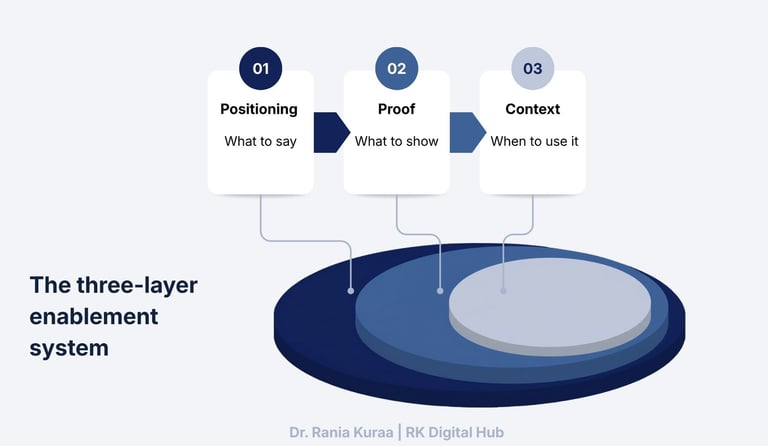
Stop thinking about enablement as content delivery. Start thinking about it as three layers: positioning, proof, and context.
1. Positioning: what to say.
Every sales stage needs a clear positioning message. Not a script. A message framework that answers: what does the buyer care about at this stage? What's the one thing we need them to understand before they move to the next stage? What language do they use to describe their problem (not our language, theirs)?
Build one positioning doc per stage. Keep it to one page. Update it quarterly based on feedback from sales (Issue 13's feedback loop feeds directly into this).
2. Proof: what to show.
Map your proof assets to buyer objections, not to content types. "Case study" is a content type. "Proof that we reduce implementation time by 60%" is a mapped asset. When a buyer says "your implementation timeline concerns me," the rep needs to know exactly which story to tell and where to find it.
Build a proof matrix: rows are the top 8 to 10 buyer objections, columns are the proof types (customer story, metric, third-party validation, comparison). Fill in the cells. Empty cells are your content gaps. Full cells with outdated content are your refresh priorities.
3. Context: when to use it.
For every piece of enablement content, add three lines of context: when to use this (which stage, which objection, which persona), when not to use this (situations where it backfires or doesn't apply), and how to frame it (the setup line that makes the content land). Three lines. That's all it takes to turn a filing cabinet into a system.
How to Fix the Enablement System
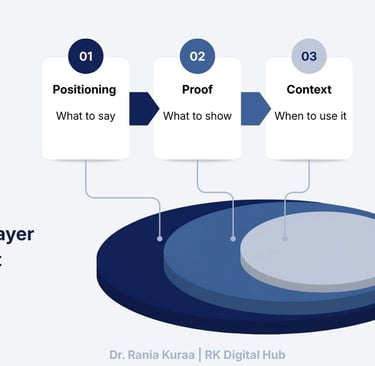
Stop thinking about enablement as content delivery. Start thinking about it as three layers: positioning, proof, and context.
1. Positioning: what to say.
Every sales stage needs a clear positioning message. Not a script. A message framework that answers: what does the buyer care about at this stage? What's the one thing we need them to understand before they move to the next stage? What language do they use to describe their problem (not our language, theirs)?
Build one positioning doc per stage. Keep it to one page. Update it quarterly based on feedback from sales (Issue 13's feedback loop feeds directly into this).
2. Proof: what to show.
Map your proof assets to buyer objections, not to content types. "Case study" is a content type. "Proof that we reduce implementation time by 60%" is a mapped asset. When a buyer says "your implementation timeline concerns me," the rep needs to know exactly which story to tell and where to find it.
Build a proof matrix: rows are the top 8 to 10 buyer objections, columns are the proof types (customer story, metric, third-party validation, comparison). Fill in the cells. Empty cells are your content gaps. Full cells with outdated content are your refresh priorities.
3. Context: when to use it.
For every piece of enablement content, add three lines of context: when to use this (which stage, which objection, which persona), when not to use this (situations where it backfires or doesn't apply), and how to frame it (the setup line that makes the content land). Three lines. That's all it takes to turn a filing cabinet into a system.
What to Do This Week
First, ask five reps the same question: "What's the last piece of marketing content you used in a deal?" If they can't name one, or if they all name different things, your enablement system isn't operating. You're producing content into a void.
Second, pull up your enablement portal and count the assets. Then check usage data if you have it. The gap between what's available and what's used tells you exactly how much waste the system produces.
Third, pick your most common buyer objection. Find every piece of content that addresses it. Put them in one place. Add three lines of context to each: when to use, when not to use, how to frame. That single exercise creates more enablement value than a new portal ever will.
The System View
This series has now covered five structural gaps. The handoff gap (Issue 10) kills leads between marketing and sales. The selection gap (Issue 11) blocks buyers from shortlisting you. The measurement trap (Issue 12) hides problems behind green dashboards. The feedback gap (Issue 13) prevents the system from learning. The enablement breakdown disconnects what marketing builds from what sales needs.
Notice the pattern: every gap sits at a connection point. Between teams. Between systems. Between intent and execution. GTM doesn't break inside the functions. It breaks between them.
An enablement system that works doesn't require a bigger content team. It requires a shared operating model where marketing builds with sales context, sales uses with positioning discipline, and both teams improve through feedback. That's the operating system.
The GTM teams that close deals consistently aren't the ones with the most content. They're the ones where sales can find, trust, and deploy what marketing builds, at the moment it matters.
FAQs
What is sales enablement in B2B?
Sales enablement is a system that connects positioning, proof, and buyer context to the sales conversation at each stage of the deal. It's not a content library or a portal. It's an operating layer that ensures reps have the right message, the right evidence, and the right framing when they need it.
Why does most marketing content go unused by sales?
Because the content is built on marketing's calendar, not mapped to sales stages or buyer objections. Research shows 65% of marketing content goes completely unused. The content exists, but it has no operating instructions. Reps can't find it, don't trust it, or don't know when to use it.
What's the difference between enablement and a content library?
A content library stores assets. An enablement system maps those assets to buyer stages, objections, and personas, then adds context (when to use, when not to use, how to frame). The library gives you ingredients. The system gives you the recipe.
How do I know if my enablement system is broken?
Ask five reps what marketing content they used in their last deal. If they can't name anything, or they all name different things, the system isn't operating. Also check: if reps regularly rebuild their own decks and emails from scratch, that's a signal the existing content doesn't fit the conversation.
What is a proof matrix in sales enablement?
A proof matrix maps your top buyer objections (rows) against proof types (columns: customer stories, metrics, third-party validation, comparisons). Each cell contains the specific asset that addresses that objection with that type of proof. Empty cells are your content gaps. This structure turns scattered proof into a deployable system.
How does enablement connect to the rest of the GTM system?
Enablement is the delivery layer of your GTM operating system. It carries positioning into sales conversations, deploys proof at the right moment, and uses context from the feedback loop (Issue 13) to keep improving. Without it, marketing's work never reaches the buyer through sales.
Ready to Fix Your GTM System?
If your sales team can't find, trust, or deploy what marketing builds, the problem isn't the people.
It's the system between them.
I help B2B companies build GTM operating systems that connect positioning, proof, content, enablement, and feedback into one revenue signal.
A GTM Audit can help you diagnose where targeting, scoring, handoff, content, and feedback systems break across your revenue engine.
Book a GTM Audit to find the gaps slowing your growth.
Join revenue leaders and B2B founders who use The GTM Operating System to build tighter systems, sharper positioning, and more predictable pipeline.
Ready to Fix Your GTM System?
If your sales team can't find, trust, or deploy what marketing builds, the problem isn't the people.
It's the system between them.
I help B2B companies build GTM operating systems that connect positioning, proof, content, enablement, and feedback into one revenue signal.
A GTM Audit can help you diagnose where targeting, scoring, handoff, content, and feedback systems break across your revenue engine.
Book a GTM Audit to find the gaps slowing your growth.
Join revenue leaders and B2B founders who use The GTM Operating System to build tighter systems, sharper positioning, and more predictable pipeline.
Sources
Gartner, “Gartner Sales Survey Finds 67% of B2B Buyers Prefer a Rep-Free Experience,” March 9, 2026.
Forrester, “It’s Not Content, It’s a Lack of Buyer Insights That’s the Problem,” January 29, 2014.
Salesforce, “New Research Reveals Sales Reps Need a Productivity Overhaul,” December 8, 2022.
G2, “70 Sales Enablement Statistics for 2025 That’ll Blow Your Mind,” December 23, 2024.
Sources
Gartner, “Gartner Sales Survey Finds 67% of B2B Buyers Prefer a Rep-Free Experience,” March 9, 2026.
Forrester, “It’s Not Content, It’s a Lack of Buyer Insights That’s the Problem,” January 29, 2014.
Salesforce, “New Research Reveals Sales Reps Need a Productivity Overhaul,” December 8, 2022.
G2, “70 Sales Enablement Statistics for 2025 That’ll Blow Your Mind,” December 23, 2024.
About The Author
Dr. Rania Kuraa
Dr. Rania Kuraa is the Founder and CEO of RK Digital Hub, a B2B marketing consultancy that builds revenue-connected GTM systems for growth-stage and enterprise companies. With a DBA and over 15 years of experience in executive marketing leadership, she's served as CMO and Director of Marketing for organizations across multiple industries.
Dr. Kuraa created the ECO Model, a framework for building GTM operating systems that connect marketing, sales, and revenue operations into a single signal. Her work focuses on the structural gaps where pipeline leaks, not the campaigns that try to fill them.
She writes The GTM Operating System, a newsletter for CEOs, revenue leaders, and B2B founders who want GTM systems that produce outcomes, not just activity.


About The Author
Dr. Rania Kuraa
Dr. Rania Kuraa is the Founder and CEO of RK Digital Hub, a B2B marketing consultancy that builds revenue-connected GTM systems for growth-stage and enterprise companies. With a DBA and over 15 years of experience in executive marketing leadership, she's served as CMO and Director of Marketing for organizations across multiple industries.
Dr. Kuraa created the ECO Model, a framework for building GTM operating systems that connect marketing, sales, and revenue operations into a single signal. Her work focuses on the structural gaps where pipeline leaks, not the campaigns that try to fill them.
She writes The GTM Operating System, a newsletter for CEOs, revenue leaders, and B2B founders who want GTM systems that produce outcomes, not just activity.