The Feedback Gap: Why Your GTM System Never Gets Smarter
The feedback gap keeps GTM teams repeating the same targeting, scoring, and content mistakes. Learn how to build a loop that helps sales and marketing learn faster.
THE GTM OPERATING SYSTEM
Dr. Rania Kuraa
6/2/20269 min read
The feedback gap happens when sales outcomes never return to the GTM decisions that created them.
Marketing keeps targeting, scoring, and creating content based on assumptions. Sales keeps rejecting leads without structured feedback flowing back into the system. Leadership keeps asking why pipeline quality is inconsistent.
The system doesn’t learn because no one built the loop.
THE GTM OPERATING SYSTEM
The Feedback Gap
Why Your GTM System Never Gets Smarter
ISSUE 13
What is the feedback gap?
Every GTM team makes mistakes.
Wrong targeting. Weak messaging. Leads that look qualified on paper but stall in sales. Campaigns that generate activity but not real buying intent.
That’s normal. Every system produces errors.
What’s not normal is making the same mistakes quarter after quarter.
That’s the feedback gap.
Definition: The feedback gap is the missing loop between sales outcomes and GTM inputs. It happens when lead rejection reasons, deal loss patterns, buyer objections, and conversion data do not flow back into targeting, scoring, messaging, content, or campaign decisions.
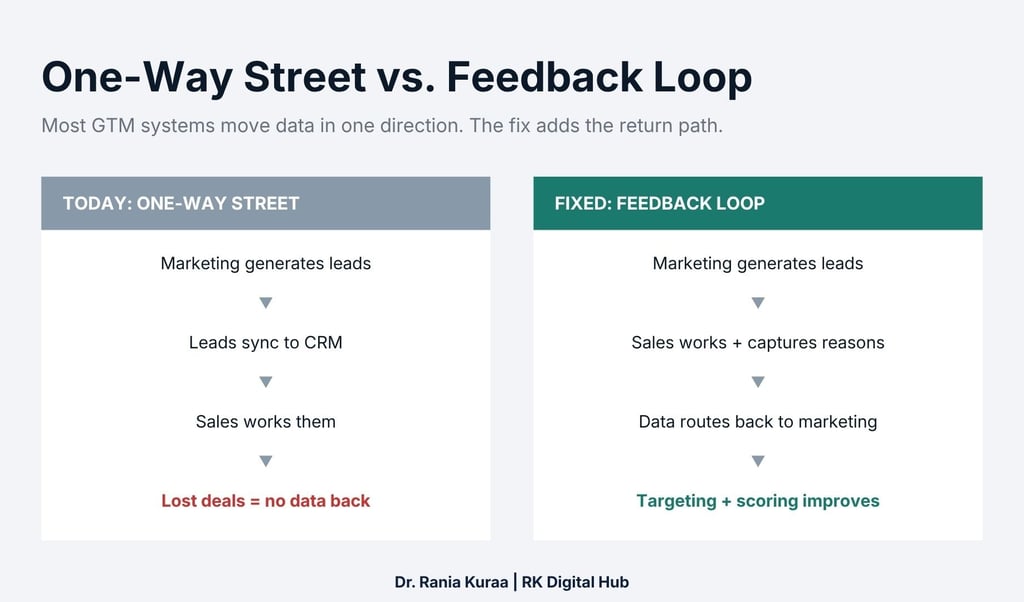
Marketing generates leads. Sales works them. Some convert. Most don’t. But the reasons why they didn’t convert never make it back to the teams and systems that created them.
So marketing keeps sending the same mix.
Sales keeps rejecting the same leads.
Both teams stay frustrated.
The system never learns.
How the Feedback Gap Forms
The gap doesn't exist because people don't care. It exists because no one built the loop.
In most B2B companies, marketing and sales operate in separate systems with separate data models. Marketing lives in the MAP (marketing automation platform). Sales lives in the CRM. The two tools connect through a sync that moves leads from one to the other. But that sync is a one-way street. Data flows from marketing to sales. What flows back? Almost nothing.
When a sales rep disqualifies a lead, they mark it "closed-lost" or "disqualified" and move on. The reason (if one exists) lives in a free-text field that nobody reads. The data sits in the CRM. Marketing never sees it. Marketing ops might pull a quarterly report, but by then the information is stale and stripped of context.
Gartner predicted that 75% of the highest-growth companies would deploy a RevOps model by 2025. The idea was right: unify the data, unify the teams, unify the process. But most companies adopted the title without building the infrastructure. They hired a VP of Revenue Operations and kept the same disconnected systems underneath. The feedback loop didn't materialize because nobody built the pipes.
There's also a cultural layer. Sales teams learn early that giving detailed feedback on disqualified leads creates more work, not less. If a rep writes "wrong title, no budget authority," marketing might respond with questions, meetings, or (worse) more leads that look exactly the same. So reps learn the fastest path: mark it lost, write nothing, move on.
The result is a system where the most valuable data in the entire revenue process (why deals fail) gets generated, discarded, and forgotten every single day.
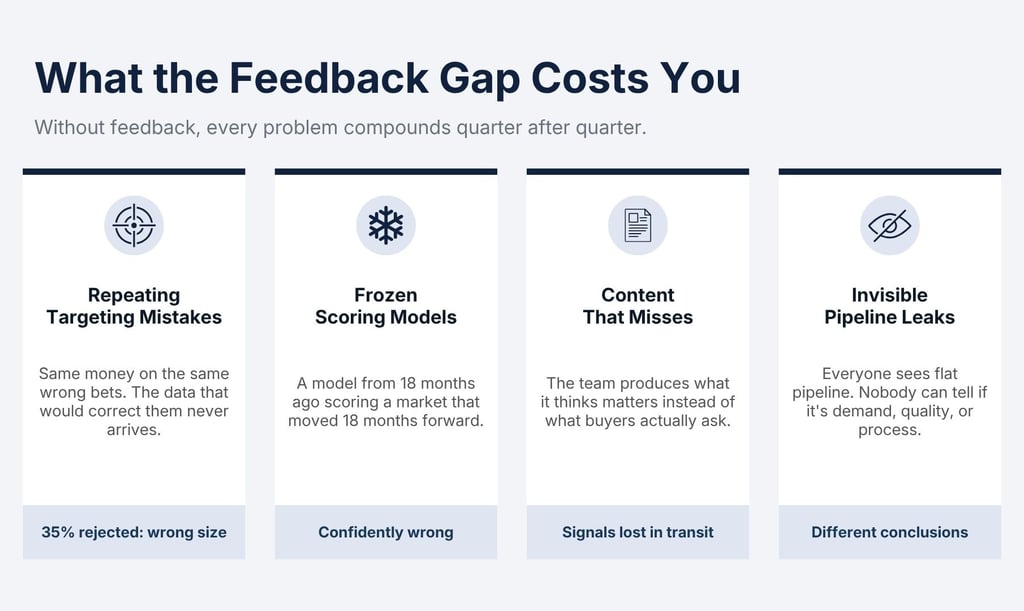
What the Feedback Gap Costs You
Without feedback, every problem compounds.
1. Targeting keeps repeating the same wrong bets.
If marketing doesn't know that 35% of its MQLs get rejected because the company size is too small, it keeps targeting small companies. If it doesn't know that leads from a specific campaign consistently stall at the discovery stage, it keeps running that campaign. The same money gets spent on the same wrong bets because the data that would correct them never arrives.
2. Lead scoring becomes confidently wrong.
Lead scoring should evolve. A model built 18 months ago reflected the ICP and buying signals of 18 months ago. Markets shift. Buyer behavior changes. New competitors enter. Without feedback from sales on which scored leads actually convert, the model stays frozen while the market moves around it. You end up with a scoring system that's confidently wrong.
3. Content misses the sales conversation.
Content strategy should respond to what buyers actually care about during the sales process. If sales regularly hears "we didn't understand how your solution handles compliance," that's a content signal. If prospects consistently ask about integration timelines, that's a content gap. But if nobody carries those signals back to the content team, the team keeps producing what it thinks matters instead of what actually does.
4. Pipeline leaks stay invisible.
Issue 10 covered the handoff gap. Issue 12 covered the measurement trap. The feedback gap is what keeps both problems hidden. Without closed-loop data, marketing can't see where leads leak after handoff. Sales can't explain why certain lead sources produce better conversations. Leadership can't distinguish a demand problem from a quality problem from a process problem. Everyone looks at the same flat pipeline and reaches different conclusions.
Why "Alignment" Doesn't Fix It
Most companies try to solve the feedback gap with alignment meetings. Marketing and sales sit in a room once a month and talk about lead quality. Sales says the leads are weak. Marketing says the leads aren't getting followed up on. Both leave frustrated. Nothing changes.
Alignment meetings fail because they rely on anecdotes instead of data. A rep says "the last five leads were garbage." Marketing says "our MQL-to-SQL rate is 22%." Neither statement helps because neither is specific enough to act on.
Forrester's research on revenue engine alignment found that this kind of structural change requires more than meetings. It requires shared data, shared metrics, and shared accountability for outcomes. Alignment isn't a conversation. It's an operating model.
Think of it like two departments in a hospital that need to coordinate patient care. You wouldn't fix that with a monthly meeting where doctors and nurses share opinions about how things are going. You'd build a shared patient record that both teams update in real time. That record is the feedback loop. Without it, coordination depends on memory and goodwill. Both run out fast.
How to Build the Feedback Loop
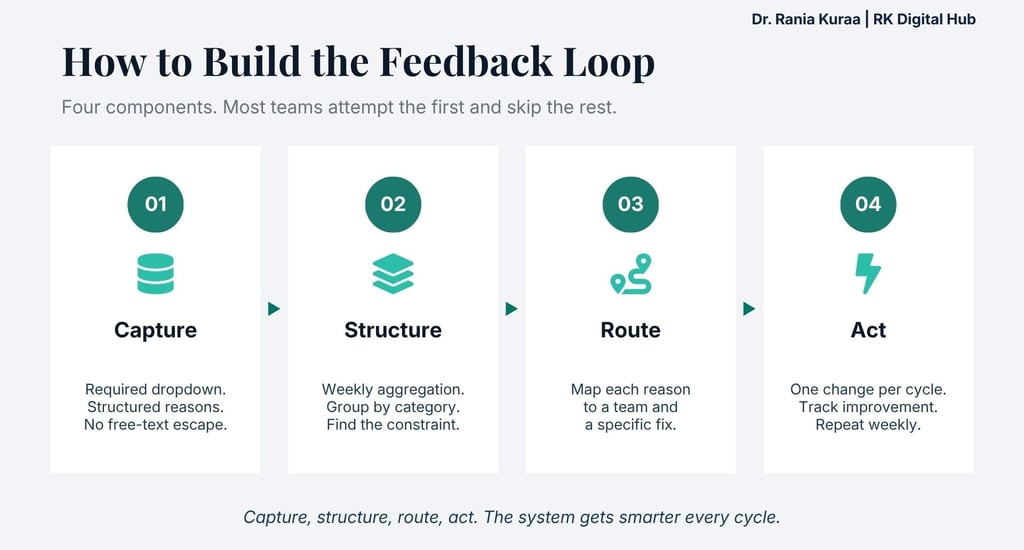
A feedback loop needs four components: capture, structure, routing, and action. Most teams attempt the first and skip the rest.
1. Capture: make rejection reasons required and structured.
When sales disqualifies a lead, the reason can't be optional and it can't be free-text. Build a dropdown with five to eight specific options: wrong company size, wrong title/role, no confirmed pain, timing not right, already using a competitor, no budget, duplicate/existing customer. Add an optional notes field for context. Make the dropdown mandatory before a lead can move to "disqualified."
This single change generates the raw material for everything else. Without structured rejection data, there's nothing to analyze.
2. Structure: aggregate the data weekly.
Every Friday (or whatever cadence fits your team), pull the rejection reasons from the past week. Group them by category. Calculate percentages. "Wrong company size" was 28% of rejections. "No confirmed pain" was 22%. "Wrong title" was 18%. Those three categories account for 68% of all rejected leads.
Now you have a constraint map. You know exactly where the system breaks.
3. Route: send the data to the right team.
"Wrong company size" goes to demand gen (targeting problem). "No confirmed pain" goes to content and nurture (education problem). "Wrong title" goes to marketing ops (scoring problem). Each rejection category maps to a specific team and a specific fix.
This is where most feedback attempts die. The data gets collected but sits in a report that nobody owns. Route it to a person, attach it to a meeting, and tie it to a specific next action.
4. Action: close the loop with visible changes.
The team that receives the feedback makes one change per cycle. Demand gen adjusts company size filters. Content creates a new asset addressing the confirmed-pain gap. Marketing ops raises the scoring threshold for certain titles. Then the team tracks whether the next batch of leads shows improvement.
That's the loop. Capture, structure, route, act. Repeat weekly. The system gets smarter every cycle because the output data feeds back into the input decisions.
The 10-Minute Feedback Audit
Answer these six questions about your current GTM system:
1. When sales disqualifies a lead, does the reason get captured in a structured format? Or is it free-text, optional, or missing entirely?
2. Can you pull a report right now showing the top five reasons leads were rejected last quarter? If you can't, the data doesn't exist or nobody looks at it.
3. Does marketing receive regular (weekly or biweekly) data on which leads converted and which didn't? Not a quarterly summary. Regular, actionable data.
4. Has your lead scoring model been updated based on actual conversion data in the last six months? If not, it's scoring based on assumptions, not outcomes.
5. Can your content team name three specific objections or questions that sales hears regularly? If not, content strategy isn't connected to the sales conversation.
6. When marketing changes targeting or scoring based on feedback, does sales see the impact within 30 days? If the loop takes longer than a month to complete, it's too slow to matter.
If you answered "no" to three or more, you don't have a feedback loop. You have a feedback wish.
What to Do This Week
You don't need a RevOps transformation to start closing this gap. You need three moves.
First, build the dropdown. Open your CRM. Create a required "Disqualification Reason" field on the lead or opportunity object with six to eight structured options. No free-text as the primary input. This takes an hour to configure and changes everything about the data you collect from this point forward.
Second, pull last month's disqualified leads and manually categorize them. Even without structured data from the past, you can read through the notes and group them. The exercise will show you patterns you didn't know existed. Most teams find that two or three rejection reasons account for the majority of lost leads. Those are your highest-impact fixes.
Third, schedule a 30-minute weekly review where one person from marketing and one from sales look at the rejection data together. Not a big alignment meeting. Not a cross-functional workshop. Two people, one report, one decision about what to change next week. Start small. Let the data build trust between the teams. Expand the meeting only when the data demands it.
Four weeks of this and you'll have a dataset that tells you exactly where your GTM system breaks. Eight weeks and you'll start making different targeting and scoring decisions. That's the feedback loop working. Not because someone mandated alignment, but because the data made the next step obvious.
The System View
This series has covered four structural gaps in the GTM operating system. The handoff gap (Issue 10) kills leads between marketing and sales. The selection gap (Issue 11) prevents buyers from shortlisting you. The measurement trap (Issue 12) hides problems behind green dashboards. The feedback gap keeps all three from getting fixed.
Feedback is the nervous system of a GTM operating model. Without it, the system can't feel where it's broken. It can't learn from its mistakes. It can't adapt to a market that changes every quarter.
A GTM system without feedback is a system running on last year's assumptions with this year's budget. It will produce activity. It won't produce improvement.
The fix takes less time than you think. One structured dropdown in the CRM. One weekly report. One meeting where marketing and sales look at rejection data together and make one change. That's it. Four weeks of that and you'll see patterns you never knew existed. Eight weeks and your lead quality starts to shift. Twelve weeks and you'll wonder how you ever operated without it.
The GTM teams that win don't generate more leads than everyone else. They learn faster. And learning requires a loop.
FAQ
What is a GTM feedback gap?
A GTM feedback gap is the missing loop between sales outcomes and GTM decisions. It happens when rejection reasons, loss patterns, buyer objections, and conversion data do not flow back into targeting, scoring, messaging, content, or campaign strategy.
Why do sales and marketing feedback loops fail?
They fail when feedback lives in free-text CRM fields, quarterly reports, anecdotal meetings, or disconnected systems. Without structured data, clear ownership, and a regular review cadence, the system cannot learn from outcomes.
How do you fix a GTM feedback gap?
Start by making rejection reasons required and structured in the CRM. Then review the data weekly, group the patterns, route each issue to the right owner, and make one measurable change per cycle.
What data should marketing get from sales?
Marketing should receive structured data on rejected leads, closed-lost reasons, buyer objections, stalled deal patterns, lead source quality, and content gaps that appear during sales conversations.
How often should sales and marketing review feedback data?
Weekly works best for active GTM teams. Monthly creates too much delay, and quarterly turns feedback into archaeology with nicer slides.
Need to find where your GTM system stops learning?
If your sales team keeps rejecting leads and your marketing team keeps wondering why, the problem probably isn’t effort.
It’s the loop.
A GTM Audit can help you diagnose where targeting, scoring, handoff, content, and feedback systems break across your revenue engine.
Book a GTM Audit to find the gaps slowing your growth.
Join revenue leaders and B2B founders who use The GTM Operating System to build tighter systems, sharper positioning, and more predictable pipeline.
Sources
· Gartner, “75% of Highest Growth Companies Will Deploy a RevOps Model”
· Forrester, “B2B Revenue Engine Alignment: A Cultural Transformation”
· Gartner, “Revenue Operations: Best Practices & RevOps Guide”
About The Author
Dr. Rania Kuraa
Dr. Rania Kuraa is the Founder & CEO of RK Digital Hub. She helps B2B tech, SaaS, and professional services companies scale from $1M to $10M ARR by fixing GTM gaps across positioning, pipeline, content systems, and revenue execution.
This article is part of The GTM Operating System, a weekly series on revenue architecture, GTM gaps, and content systems for B2B growth teams.


Rania Kuraa.
Strategic growth, GTM, and commercial advisory for B2B leaders navigating complex growth decisions.
EXPLORE
© 2026 Rania Kuraa. All rights reserved.
Privacy Policy · Terms of Use