The Marketing-to-Sales Handoff Gap: Why 30%+ of Inbound Leads Never Get Contacted
Fix the marketing-to-sales handoff gap with one owner, a clear SLA, and a weekly feedback loop before qualified leads quietly die in your CRM.
THE GTM OPERATING SYSTEM
Dr. Rania Kuraa
5/5/202611 min read
The Marketing-to-Sales Handoff Gap: Why 30%+ of Inbound Leads Never Get Contacted
The marketing-to-sales handoff gap is the ownerless space between a marketing-qualified lead and a sales conversation. Leads enter the CRM, trigger a notification, and stall because nobody owns the transition. Fix it with one defined handoff stage, one accountable owner, a tiered response-time SLA, and a weekly feedback loop between marketing and sales.
THE GTM OPERATING SYSTEM


Dr. Rania Kuraa
June 9, 2026 . 8 min read
Key Takeaways
A lead handoff needs an owner, not a notification.
High-intent inbound leads need a response in minutes, not days.
MQL, SAL, and SQL stages need explicit entry and exit rules.
Sales rejection reasons should feed targeting, scoring, and nurture decisions.
Handoff volume, velocity, and conversion reveal revenue leaks that endpoint metrics hide.
Last issue, I made the case that your sales team isn’t the problem. Your GTM system is.
This issue goes one layer deeper. If your revenue system has a single point of failure, it sits in the handoff.
Think about a relay race. Marketing runs the first leg. Sales runs the second. Both teams train hard. Both teams track their own speed. Then the baton hits the ground in the transition zone because nobody practiced the pass.
It doesn’t matter how fast your runners are if the baton is lying on the track.
That’s what happens when a lead stops being marketing’s responsibility but hasn’t become sales’ priority. The lead cools off. The buyer moves on. The CRM keeps the record, like a tiny digital graveyard with excellent filters.
The Marketing-to-Sales Handoff Gap: Why 30%+ of Inbound Leads Never Get Contacted
The marketing-to-sales handoff gap is the ownerless space between a marketing-qualified lead and a sales conversation. Leads enter the CRM, trigger a notification, and stall because nobody owns the transition. Fix it with one defined handoff stage, one accountable owner, a tiered response-time SLA, and a weekly feedback loop between marketing and sales.
THE GTM OPERATING SYSTEM
Dr. Rania Kuraa
June 16, 2026 . 8 min read
Key Takeaways
A lead handoff needs an owner, not a notification.
High-intent inbound leads need a response in minutes, not days.
MQL, SAL, and SQL stages need explicit entry and exit rules.
Sales rejection reasons should feed targeting, scoring, and nurture decisions.
Handoff volume, velocity, and conversion reveal revenue leaks that endpoint metrics hide.
Last issue, I made the case that your sales team isn’t the problem. Your GTM system is.
This issue goes one layer deeper. If your revenue system has a single point of failure, it sits in the handoff.
Think about a relay race. Marketing runs the first leg. Sales runs the second. Both teams train hard. Both teams track their own speed. Then the baton hits the ground in the transition zone because nobody practiced the pass.
It doesn’t matter how fast your runners are if the baton is lying on the track.
That’s what happens when a lead stops being marketing’s responsibility but hasn’t become sales’ priority. The lead cools off. The buyer moves on. The CRM keeps the record, like a tiny digital graveyard with excellent filters.
Why Leads Die Between Marketing and Sales
The handoff gap isn’t a people problem. It’s a structural problem. Structural problems need structural fixes.
Here’s the pattern: marketing builds a scoring model around behavior. A contact downloads an ebook, attends a webinar, opens a few emails, or visits a pricing page. The CRM pushes the contact across an MQL threshold and alerts sales.
The rep opens the record. The context is thin. The buyer’s problem isn’t clear. The decision process is invisible. The timing is a shrug in a dropdown menu.
So the rep makes a rational judgment call: “This isn’t worth my time right now.”
The lead sits. Marketing reports an MQL. Sales reports flat pipeline. Both teams tell the truth. They’re looking at different sides of a broken process.
The root cause is simple: the handoff has no owner, no SLA, and no feedback loop.
The Numbers Are Ugly
XANT’s lead-response infographic reports that more than 30% of leads never receive contact at all. Its response audit also found that half of submitted leads received no response. [1]
Harvard Business Review published a separate study showing that companies reaching out within an hour were nearly seven times more likely to qualify a lead than companies waiting an additional hour, and more than 60 times more likely than companies waiting 24 hours or longer. [2]
The InsideSales.com/MIT Lead Response Management Study found an even sharper curve for web-generated inquiries: calling within five minutes instead of 30 minutes increased the odds of contact by 100 times and qualification by 21 times. [3]
These studies focus on web-generated leads, not every B2B motion. The operational lesson still holds: intent decays fast. You’re not losing every deal to a competitor. You’re losing a chunk of them to dead air.
What the Handoff Gap Costs You
1. Direct revenue loss
You already paid to create demand: content, media, events, tools, and team time. When a qualified buyer gets no response, that investment produces a CRM record instead of pipeline.
2. Trust erosion
A buyer fills out a form or replies to outreach and hears nothing back. You train that buyer to ignore you next time. That isn’t only a lost deal. It’s a damaged relationship with someone who could return next quarter.
3. Internal friction
Marketing says sales doesn’t follow up. Sales says marketing sends garbage. Both teams build a case against the other side. Soon, each meeting turns into a polite little courtroom drama.
4. Distorted data
When leads die in the gap, your funnel metrics describe a broken process instead of market demand. Cost per opportunity rises. Conversion rates fall. Teams respond by buying more traffic, changing campaigns, or blaming the ICP. The leak stays open.
How to Close the Marketing-to-Sales Handoff Gap
The fix doesn’t require a reorg or a new stack. It requires a decision: somebody owns the space between marketing and sales.
1. Define the handoff stage
Create a stage between MQL and SQL. Call it SAL, Sales Accepted Lead, Handoff Queue, or something your team will use without rolling its eyes.
Give that stage clear entry criteria and clear exit criteria. A content download alone doesn’t justify sales attention. A demo request from an ICP-fit account does.
Every lead must move in one of two directions: forward to SQL for active sales work, or back to marketing for nurture. The handoff queue isn’t a waiting room with old magazines.
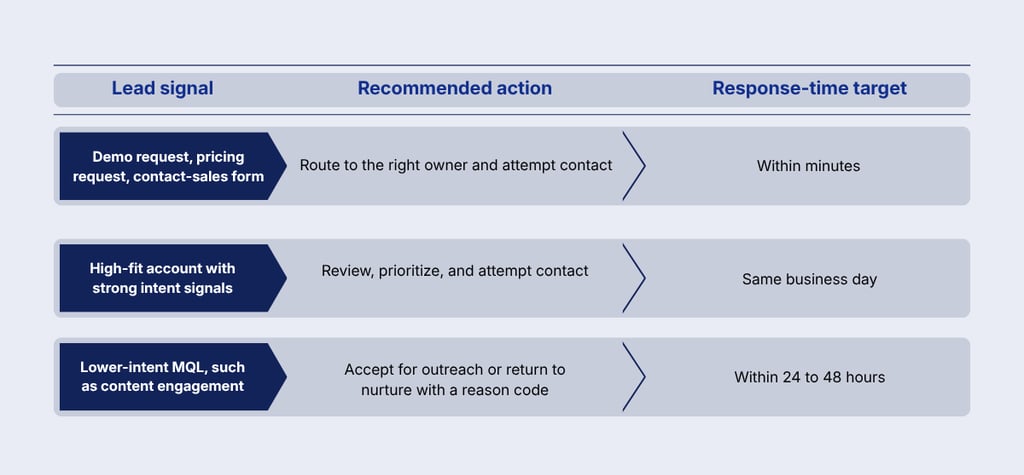
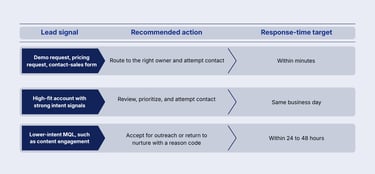
2. Match the SLA to buyer intent
A demo request and an ebook download do not deserve the same clock. Use a tiered SLA.
The exact thresholds depend on your motion. The rule doesn’t: no lead enters the handoff stage without a clock.
3. Assign one accountable owner
One person or team owns the handoff stage. In a smaller company, that owner can be a senior SDR or revenue operations lead. In a larger company, sales development or a revenue operations workflow can own routing and SLA enforcement.
Ownership means the team contacts the lead, accepts it, or returns it with a reason code. “Reviewed” doesn’t count.
4. Build a feedback loop
When sales returns a lead, require a specific reason. “Not a fit” tells you nothing. “Company below minimum contract size” tells marketing to refine targeting. “Wrong seniority” tells marketing to fix scoring. “Timing is Q3” tells marketing to nurture the account.
Review rejection reasons every week. Use the patterns to adjust targeting, scoring, content, and nurture. This turns the handoff into a learning system instead of a blame exchange.
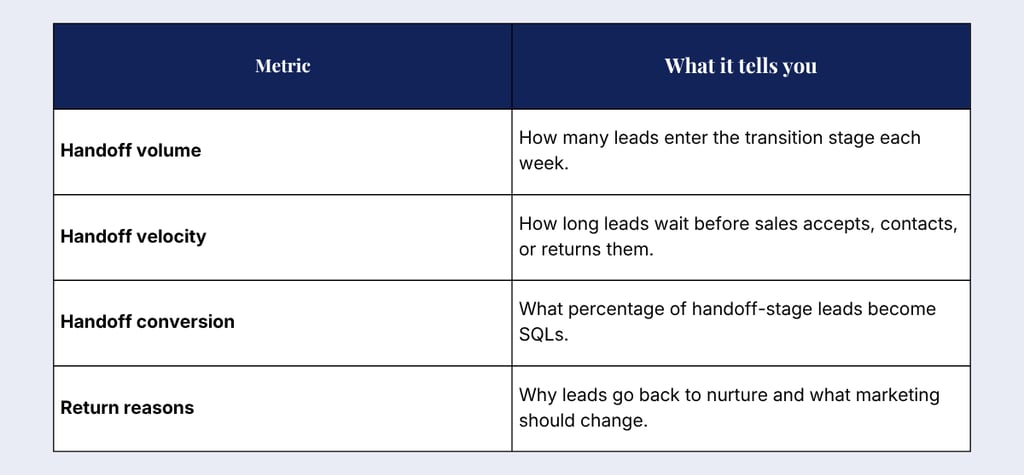
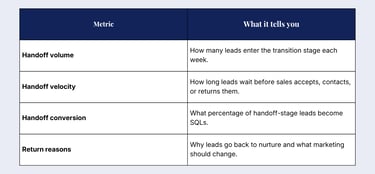
5. Measure the gap, not only the endpoints
Most teams track leads generated and pipeline created. Track the space between them too.
If volume is high and conversion is low, your scoring model needs work. If volume is low and conversion is high, focus on demand creation. If velocity is slow, fix routing, capacity, or accountability.
How to Close the Marketing-to-Sales Handoff Gap
The fix doesn’t require a reorg or a new stack. It requires a decision: somebody owns the space between marketing and sales.
1. Define the handoff stage
Create a stage between MQL and SQL. Call it SAL, Sales Accepted Lead, Handoff Queue, or something your team will use without rolling its eyes.
Give that stage clear entry criteria and clear exit criteria. A content download alone doesn’t justify sales attention. A demo request from an ICP-fit account does.
Every lead must move in one of two directions: forward to SQL for active sales work, or back to marketing for nurture. The handoff queue isn’t a waiting room with old magazines.
2. Match the SLA to buyer intent
A demo request and an ebook download do not deserve the same clock. Use a tiered SLA.
The exact thresholds depend on your motion. The rule doesn’t: no lead enters the handoff stage without a clock.
3. Assign one accountable owner
One person or team owns the handoff stage. In a smaller company, that owner can be a senior SDR or revenue operations lead. In a larger company, sales development or a revenue operations workflow can own routing and SLA enforcement.
Ownership means the team contacts the lead, accepts it, or returns it with a reason code. “Reviewed” doesn’t count.
4. Build a feedback loop
When sales returns a lead, require a specific reason. “Not a fit” tells you nothing. “Company below minimum contract size” tells marketing to refine targeting. “Wrong seniority” tells marketing to fix scoring. “Timing is Q3” tells marketing to nurture the account.
Review rejection reasons every week. Use the patterns to adjust targeting, scoring, content, and nurture. This turns the handoff into a learning system instead of a blame exchange.
5. Measure the gap, not only the endpoints
Most teams track leads generated and pipeline created. Track the space between them too.
If volume is high and conversion is low, your scoring model needs work. If volume is low and conversion is high, focus on demand creation. If velocity is slow, fix routing, capacity, or accountability.
The System View
The handoff gap is a symptom. The disease is treating marketing and sales as separate functions with separate finish lines.
Marketing optimizes for lead volume. Sales optimizes for pipeline and close rate. Nobody optimizes the transition. That’s where revenue leaks.
Revenue is one system. Demand generation creates inputs. The handoff and sales process convert those inputs. Closed deals and retention create outputs. When you optimize each function in isolation, the seams split.
Run this 15-minute gut check
Pull last quarter’s MQL count.
Pull the number of leads sales accepted.
Pull the number of leads sales contacted within your SLA.
Subtract the contacted leads from the handoff-stage leads.
Review the stalled records and group them by reason: routing, ownership, capacity, weak fit, weak intent, or missing data.
That gap is your first repair list. Pick one owner. Give every lead a clock. Review the queue each week. Let the data shape the next month of marketing and sales decisions.
You don’t need another campaign to start. You need a clean baton pass.
FAQs
What is a marketing-to-sales handoff?
A marketing-to-sales handoff is the point where marketing transfers a qualified lead to sales for review, contact, or active pursuit. A strong handoff includes qualification criteria, context, routing rules, an accountable owner, and a response-time SLA.
What is the difference between an MQL, SAL, and SQL?
An MQL has shown enough fit or interest to qualify for a defined next step. An SAL is a lead sales has reviewed and accepted for action. An SQL is ready for direct sales engagement based on stronger fit, need, authority, timing, or buying intent. The exact definitions should match your revenue motion. HubSpot also distinguishes MQLs from SQLs by sales readiness. [4]
How fast should sales follow up with an inbound lead?
Match the SLA to intent. Route demo requests, pricing inquiries, and contact-sales forms within minutes. Review lower-intent MQLs within 24 to 48 hours, then accept them for outreach or return them to nurture with a reason code. Web-lead studies show a steep drop in contact and qualification odds as response time increases. [2][3]
Who should own the handoff stage?
Assign one accountable owner. That can be an SDR leader, revenue operations lead, sales development team, or routing workflow with a named operator. The owner must ensure every lead moves forward or returns to nurture with a reason.
Which handoff metrics should a B2B team track?
Track handoff volume, handoff velocity, handoff conversion, SLA compliance, and return reasons. These metrics show whether your leak comes from weak targeting, slow routing, unclear ownership, low capacity, or poor qualification rules.
Will a new CRM fix the handoff gap?
No. A CRM can support the workflow, but software cannot replace ownership, definitions, and operating discipline. Fix the process first. Then configure the stack around the process.
Need to fix the leak inside your funnel?
SUBSCRIBE TO THE GTM OPERATING SYSTEM
Get practical GTM systems, revenue diagnostics, and operating fixes delivered to your inbox. No recycled growth hacks. No dashboard theater. Just the work that helps your team build pipeline that moves.
Sources
[1] XANT, Best Practices for Lead Response Management. Reports that more than 30% of leads never receive contact and summarizes response-audit findings.
[2] Harvard Business Review, The Short Life of Online Sales Leads. Foundational research on response speed and lead qualification.
[3] InsideSales.com / MIT Lead Response Management Study. Analyzes more than 15,000 web-generated leads and more than 100,000 call attempts.
[4] HubSpot, MQL vs. SQL: What They Are and How They Differ. Defines MQL and SQL stages through the lens of sales readiness.
[5] HubSpot, What Is Lead Management in Sales?. Frames lead management as capture, qualification, routing, nurture, tracking, and conversion supported by shared data and SLAs.
About The Author
Dr. Rania Kuraa
Dr. Rania Kuraa is the Founder and CEO of RK Digital Hub, a B2B marketing consultancy that builds revenue-connected GTM systems for growth-stage and enterprise companies. With a DBA and over 15 years of experience in executive marketing leadership, she's served as CMO and Director of Marketing for organizations across multiple industries.
Dr. Kuraa created the ECO Model, a framework for building GTM operating systems that connect marketing, sales, and revenue operations into a single signal. Her work focuses on the structural gaps where pipeline leaks, not the campaigns that try to fill them.
She writes The GTM Operating System, a newsletter for CEOs, revenue leaders, and B2B founders who want GTM systems that produce outcomes, not just activity.


About The Author
Dr. Rania Kuraa
Dr. Rania Kuraa is the Founder and CEO of RK Digital Hub, a B2B marketing consultancy that builds revenue-connected GTM systems for growth-stage and enterprise companies. With a DBA and over 15 years of experience in executive marketing leadership, she's served as CMO and Director of Marketing for organizations across multiple industries.
Dr. Kuraa created the ECO Model, a framework for building GTM operating systems that connect marketing, sales, and revenue operations into a single signal. Her work focuses on the structural gaps where pipeline leaks, not the campaigns that try to fill them.
She writes The GTM Operating System, a newsletter for CEOs, revenue leaders, and B2B founders who want GTM systems that produce outcomes, not just activity.

Rania Kuraa.
Strategic growth, GTM, and commercial advisory for B2B leaders navigating complex growth decisions.
Ways to Work Together
© 2026 Rania Kuraa. All rights reserved.
Privacy Policy · Terms of Use